 Call us today! 404-835-9000
 Join our Summer Camp
 Support Cumberland
 Why the Autism and Neurodivergent Community Is Moving Away from “High Functioning”
For years, “high-functioning autism” was one of the most common phrases used to describe autistic people who could speak, work, live independently, or otherwise “pass” in a neurotypical world. It sounded like a compliment. It sounded like clarity. And for a long time, almost nobody questioned it.
That is changing. Clinicians, researchers, and autistic people themselves, most importantly, are increasingly asking that we retire the term altogether. Here is why, and what specialists recommend using instead.
What You Will Learn:
Where the term “high-functioning autism” came from, and why it was never an official diagnosis
- Why IQ alone cannot predict how much daily support someone needs
- How masking hides the real cost of appearing “high functioning”
- Why both “high functioning” and “low functioning” labels cause harm
- What terminology, including Level 1 Autism, is replacing functioning labels today
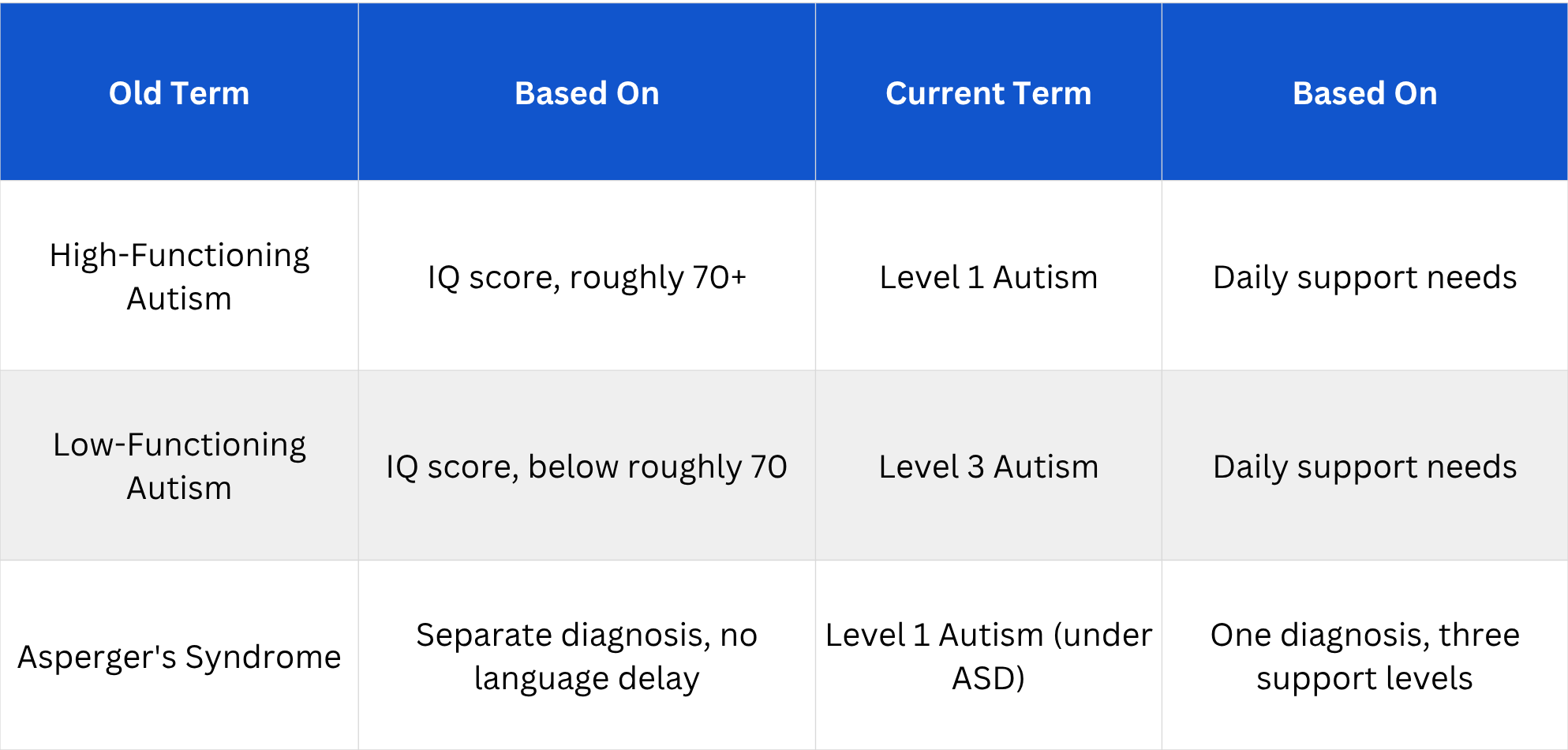
Old Terms vs. New Terms
Where Did the Term “High-Functioning Autism” Come From?
“High-functioning autism” was never an official diagnosis. It doesn’t appear in the DSM or the ICD, the two major diagnostic manuals used by psychiatrists and psychologists worldwide. It emerged informally, largely as a way to distinguish autistic people with average or above-average IQ from those with a co-occurring intellectual disability, using an IQ score of around 70 as the rough dividing line.
For decades, this label ran alongside “Asperger’s syndrome,” a separate diagnosis used for people with similar traits but no early language delay. In 2013, the DSM-5 folded both terms into a single diagnosis, Autism Spectrum Disorder, described using three support levels: (Level 1, “requires support,” through Level 3 “requires very substantial support”) rather than a functioning label. Anyone previously described as “high functioning” or diagnosed with Asperger’s now typically falls under Level 1. Families exploring what this means for schooling can see our Who We Serve page.
Why Doesn’t IQ Predict Daily Functioning in Autism?
The biggest issue with “high functioning” is that it was built almost entirely around IQ, and IQ says very little about how someone actually manages daily life. A person can have a strong vocabulary, hold a demanding job, and still struggle enormously with sensory overload, executive functioning, emotional regulation, or basic self-care tasks like cooking or keeping a routine.
Research backs this up. Autistic people frequently show an uneven cognitive profile, scoring in the typical or above-typical range for verbal and logical reasoning while scoring notably lower on processing speed. That unevenness is the rule, not the exception, which makes a single label like “high functioning” fundamentally misleading. The same person who gives a polished presentation at work might be unable to make dinner that night, or might be quietly overwhelmed in the grocery store on the way home.
Ability can even shift within a single day. Someone who handles a quiet morning meeting with ease might be completely undone by a loud, crowded afternoon. Autistic researchers have identified this kind of fluctuation as a core feature of autism itself, not an exception to explain away, which makes any fixed, static label inherently inaccurate.
Programs like our Explorers upper school are built around this kind of day-to-day variation, not a fixed label.
What Is Autistic Masking, and Why Does It Have a Real Cost?
Part of what makes someone appear “high-functioning” is often masking: the conscious or unconscious suppression of autistic traits to fit neurotypical expectations. Forcing eye contact. Rehearsing small talk. Mimicking facial expressions. Suppressing the urge to talk about a special interest. Hiding sensory distress.
Masking has a real cost. Research links higher levels of masking to increased depression, anxiety, and burnout, and many autistic adults describe years of masking eroding their sense of who they actually are. This is part of why someone who appears to be coping well can experience sudden autistic burnout, a sharp drop in capacity after months or years of effort that was never sustainable in the first place. “High functioning” tends to erase this entire process, treating the appearance of ease as if it were effortless. Our Counseling program is built to catch this kind of hidden struggle before it turns into burnout.
Why Are “High-Functioning” and “Low-Functioning” Labels Both Harmful?
“High functioning” and “low functioning” aren’t just imprecise; they actively cause harm in opposite directions:
- “High functioning” often leads to autistic people being denied services and accommodations, because the assumption becomes: you seem fine, so you must not need help. This can mean a child is expected to manage a mainstream classroom without support, even while struggling with instructions, routine changes, or peer interaction, or an adult is denied workplace accommodations because their difficulties aren’t visible.
- “Low functioning” does the reverse. It can strip someone of the assumption that they have rich inner lives, meaningful preferences, or the capacity to communicate and make decisions for themselves, limiting their autonomy and opportunities.
Many autistic adults describe the resulting bind as being simultaneously “too autistic” for neurotypical spaces and “not autistic enough” for support systems, trapped between two labels that were each built to help but function instead as a ceiling.
What Terminology Is Replacing “High-Functioning Autism”?
The shift isn’t toward vagueness. It’s toward specificity. Instead of a single blanket label, the emerging norm is to describe:
- Support needs rather than “functioning level”, since needs are specific, actionable, and can change day to day or task to task.
- Communication style and sensory profile, focused on what actually helps rather than a guess based on IQ.
- Executive function and daily living challenges, since these often matter more to quality of life than intelligence does.
Language around identity has shifted too. Multiple surveys have found that autistic adults generally prefer identity-first language (“autistic person”) over person-first language (“person with autism”), a preference the American Psychological Association now recognizes. That said, preference is individual, so the safest approach is simply to ask. Students planning ahead can also explore College at Cumberland, our post-secondary bridge program for young adults with Level 1 Autism and ADHD.
What Does This Shift Mean for Level 1 Autism and School Support?
For families evaluating a school, moving away from “high functioning autism” matters beyond terminology. A student described as having Level 1 Autism under the DSM-5 may still need real, structured support, even if they seem to be managing well on the surface. Schools built for independent learners with Level 1 Autism, like Cumberland Academy of Georgia, focus on the specific supports a student actually needs, not on how “high functioning” they appear from the outside.
If you are exploring what a Level 1 Autism diagnosis means for school choice, see our companion guide, Choosing a School Based on Autism Support Needs: Levels 1, 2, and 3, or read our full guide to autism schools in Atlanta.
When Should You Reach Out to Cumberland Academy?
- Your child was recently diagnosed with Level 1 Autism, ADHD, or a related learning difference.
- Your current school keeps calling your child “high functioning” while your child is still struggling day to day.
- Your child’s IEP isn’t being honored, or isn’t providing enough support.
- You are searching for a full college-prep option built specifically for neurodiverse students.
Contact us to talk with our admissions team.
Frequently Asked Questions
What is the difference between high-functioning autism and Level 1 autism?
“High-functioning autism” described someone based on IQ and how well they appeared to cope. Level 1 Autism, the DSM-5’s current term, describes how much support a person needs day to day, which is a more accurate way to plan for real accommodations.
Why is the term “high functioning autism” considered outdated?
It relies on IQ rather than actual daily support needs, it can lead to people being denied accommodations, and it doesn’t account for how ability can fluctuate day to day or even hour to hour.
What is autistic masking?
Autistic masking is the conscious or unconscious suppression of autistic traits, such as forcing eye contact or rehearsing small talk, to appear more neurotypical. It often makes someone look “high functioning” while hiding real struggles like sensory overload or burnout.
Does Cumberland Academy of Georgia serve families outside of Atlanta?
Yes. While Cumberland Academy is based in Atlanta, families travel from across the metro area, including Sandy Springs, Marietta, Smyrna, Kennesaw, Roswell, Decatur, and Alpharetta, and some families relocate from out of state for the right fit.
The Bottom Line
Understanding autism support levels, sensory needs, and communication style paints a far more accurate picture than any functioning label ever could. If you are trying to understand what a Level 1 Autism, ADHD, or learning-difference diagnosis means for your child’s next school in the Atlanta area, Cumberland Academy of Georgia’s admissions team can help you think it through. Schedule a tour or call 404-835-9000 to talk with our admissions team about your child’s specific needs.
Debbi Scarborough
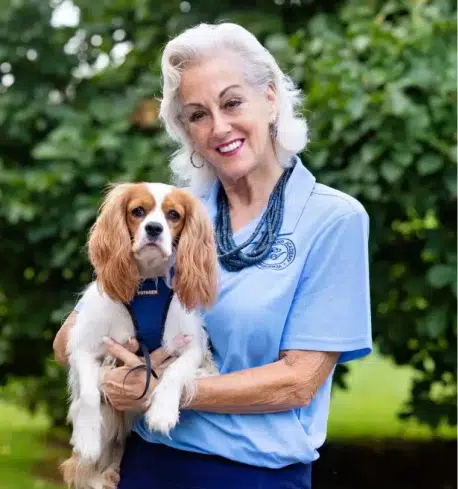
From 2007 to present, Debbi Scarborough has been the Headmaster and served on the Board of Directors for this non-profit, special needs school that focuses on children with ASD, ADD, and ADHD. Debbi and her husband Matthew founded Cumberland Academy of Georgia after a frustrating battle of searching for the right school for their son Steven who has ASD. She has built the academy from one student to now over 100, and continues to run the day to day operations.Related Posts

Cumberland Academy of Georgia Celebrates Atlanta Dream Spirit Day
Cumberland Academy of Georgia will celebrate Atlanta’s WNBA team, the Atlanta Dream, with a school-wide Atlanta Dream Spirit Wear Day....
READ POST
Understanding Twice Exceptional Students and How Cumberland Academy of Georgia Supports Them in Atlanta
If you’ve ever watched your child breeze through a complex math problem one moment and feel overwhelmed by a homework....
READ POST
Cumberland Academy of Georgia Celebrates 20 Years of Empowering Students with Learning Differences in Atlanta
Cumberland Academy of Georgia is celebrating 20 years as a school for students with learning differences in Atlanta. Founded in....
READ POST