
 Call us today! 404-835-9000
 Join our Summer Camp
 Support Cumberland
 Choosing a School Based on Autism Support Needs: Levels 1, 2, and 3
For families of a child with autism, choosing a school may begin with understanding the child’s support needs, including any autism support level identified in a clinical evaluation. The DSM-5 defines three levels of autism support needs. Each level can help families understand the amount of assistance a child may need, but the level alone does not determine the right school; academic skills, communication, behavior, sensory needs, independence, and available school services must also be considered.
Founded in 2007 and based in Sandy Springs, GA, Cumberland Academy of Georgia is a fully accredited school (COGNIA/GISA and the Georgia Accrediting Commission) built for independent learners with Level 1 autism, ADHD, and related learning differences. With small class sizes, ability grouping, and a curriculum that blends academics with social and life skills, Cumberland Academy helps families turn an autism diagnosis into a school placement conversation.
Below, we break down what Levels 1, 2, and 3 mean and share examples of the types of programs and schools built for Level 1, Level 2, and Level 3 support, including options outside Georgia.
What You Will Learn About Autism Support Levels and School Placement:
- The key differences between Level 1, Level 2, and Level 3 autism support needs
- How different support needs may influence classroom staffing and structure
- What to look for in a school for Level 1 autism, Level 2 autism, or Level 3 autism
- Practical steps for matching a diagnosis to the right learning environment
- Where Cumberland Academy fits, and when a different program may be a better match
This guide is provided for general informational and resource purposes only. It is not clinical, diagnostic, or educational placement advice. Every child’s needs are different, so school decisions should be made in consultation with qualified professionals and each school’s admissions team.
Autism Support Levels 1, 2, and 3
Autism support levels do not prescribe a specific classroom setting, staffing ratio, or school placement. The examples below are general considerations, and individual needs can vary significantly among students identified at the same level.
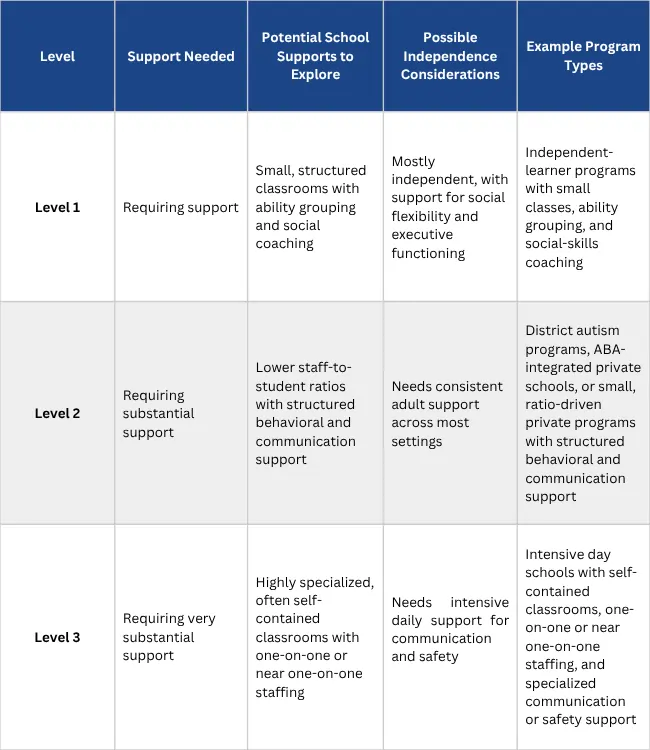
These are general program types associated with each support level, shared for informational and resource purposes only. Specific named schools appear later in this guide as illustrative examples only, not placement recommendations, referrals, or endorsements, and are not officially classified by their operating schools or districts as “Level 1,” “Level 2,” or “Level 3” programs. Confirm current eligibility and availability directly with each school.
What Are Autism Support Levels 1, 2, and 3?
Autism support levels describe how much daily support a person needs, not how “severe” their autism is in a general sense. A student identified as requiring Level 1 support may experience noticeable challenges with social communication, flexibility, transitions, or restricted and repetitive behaviors, and may participate in a group learning environment but still require structured support depending on their individual profile.
A student identified as requiring Level 2 support may need substantial support across most environments, often including structured behavioral programming, though needs vary by individual. A student identified as requiring Level 3 support may have significant communication, behavioral, sensory, or safety-related needs and may benefit from intensive, individualized assistance during the school day.
How Autism Support Levels Affect School Choice
A student’s autism support level can inform the types of classroom assistance a family may explore, but it should be considered alongside the student’s full educational and developmental profile. Matching the child’s documented needs, not merely the diagnostic level, to a school’s staffing, instructional model, and available services, covered level by level below, can help families evaluate whether a placement is likely to remain appropriate over time.
Finding a School for Level 1 Autism
Level 1 autism is sometimes still described by the outdated term “high-functioning autism.” Families searching for a school for Level 1 autism should look for small class sizes, ability grouping, and a curriculum that pairs academics with social skills coaching.
Cumberland Academy of Georgia specializes in exactly this profile, along with ADHD and related learning differences. For more on how these diagnoses map to school fit, read our full guide to autism schools in Atlanta.
Finding a School for Level 2 Autism
A school for Level 2 autism needs to offer more than small classes. These students typically need consistent adult support across the school day, structured behavior plans, and staff trained in communication supports such as visual schedules or augmentative tools. Because Cumberland Academy is designed for independent learners and does not provide continuous one-on-one aide support, it may not be the appropriate setting for a student who requires substantial adult assistance throughout the school day. Families should discuss the student’s complete support profile with Cumberland’s admissions team and other qualified professionals.
A few examples of the type of programs to look for, regardless of location:
- District autism programs, such as NYC Public Schools’ Nest and Horizon programs, which use different classroom models and eligibility standards to serve qualifying students with autism and IEPs. Eligibility for each program is based on the district’s own criteria rather than a DSM-5 level assignment, so families should review current criteria directly with the school district.
- ABA-integrated private schools, such as STAR Autism Academy in Phoenix, AZ, which serves students with significant language, communication, and behavioral needs. (Note: STAR uses its own internal “Level 1/2/3” naming for academic program tiers, which is separate from and not the same as DSM-5 autism support levels.)
- Small, ratio-driven private schools, such as Kradwell School in Wauwatosa, WI, which structures classes around a low staff-to-student ratio for students with autism and related learning differences.
Similar structured, lower-ratio programs exist in most major metro areas, so use these as a benchmark for what to ask about wherever you live.
Finding a School for Level 3 Autism
Depending on the student, Level 3 support could involve a specialized public-school program, therapeutic day school, communication-focused program, or another closely supported educational setting, often with self-contained classrooms or near one-on-one staffing. These programs differ significantly from an independent-learner model.
Nationally, examples of this type of intensive program include:
- Manhattan Children’s Center in New York, NY, an ABA-based day school for students ages 5 to 21 with autism and related neurodiversities.
- VIA Centers for Neurodevelopment (formerly the Virginia Institute of Autism) in Charlottesville, VA, built specifically around one-on-one ABA instruction.
- Therapeutic day schools, such as those affiliated with children’s hospitals and school districts, which serve students who need one-to-one support and intensive therapies alongside academics.
If your child needs this level of support, look for a placement where daily living skills, communication therapy, and behavioral health support are built into the schedule, not added on, and confirm the actual staff-to-student ratio before enrolling.
Steps to Match Your Child’s Autism Support Level to the Right School
- Gather current records and evaluations. Collect your child’s current clinical evaluation and any school records, including an IEP, 504 plan, progress reports, evaluations, and documented accommodations, then review these materials with qualified professionals to identify the supports your child uses across different settings.
- List the specific supports your child needs. Note whether they need help with social flexibility, transitions, communication, or safety, since this determines the settings worth touring.
- Tour schools that match that support level. During a visit, ask directly about staff-to-student ratios, behavioral support, and how the school handles transitions. Cumberland Academy’s admissions and shadow day process is a useful model for what to ask about at any school you tour.
- Confirm the independence expectations fit your child. A school built for independent learners will not be the right fit for a student who needs one-on-one support, and the reverse is also true.
- Reassess the placement regularly. A child’s support needs, academic abilities, and independence can change over time, so families should continue evaluating whether the school’s services remain appropriate.
Why Families Trust Cumberland Academy for Level 1 Autism Support
Cumberland Academy maintains a low student-teacher ratio and groups students by ability so instruction matches each student’s actual level. Beyond academics, students take part in social skills programming, sports, and clubs designed to build confidence alongside coursework. You can read more about our accreditations and mission to see how the program is structured day to day.
Find the Right Fit for Your Child
Matching a school to an autism support level is one of the most important decisions a family makes, and it starts with an honest look at how much daily support your child needs. If your child has Level 1 autism, ADHD, or a related learning difference and thrives with structure, small classes, and social skills coaching, Cumberland Academy of Georgia in Sandy Springs, GA may be the right fit.
Schedule a tour or call 404-835-9000 to talk with our admissions team about your child’s specific needs.
Frequently Asked Questions
What do Level 1, Level 2, and Level 3 autism support needs mean in a school setting?
Level 1 autism describes a child who may need support with social communication and flexibility and may participate in a group learning environment but still require structured support depending on their individual profile. Level 2 means substantial support is needed across most settings. Level 3 means very substantial support is needed, often with intensive communication and safety assistance throughout the school day.
How do autism support Levels 1, 2, and 3 affect school choice?
Autism support levels can help describe the type and amount of assistance a child may need, but they do not independently determine school placement. Families should also weigh academic skills, communication, behavior, sensory needs, independence, and the specific services each school offers before choosing a program.
What autism support needs is Cumberland Academy equipped to serve?
Cumberland Academy primarily serves independent students with Level 1 autism, ADHD, and related learning differences who are near or above grade level academically. The school does not provide continuous one-on-one aide support. Admissions decisions are based on whether a student’s academic, social, behavioral, and independence needs align with the school’s program.
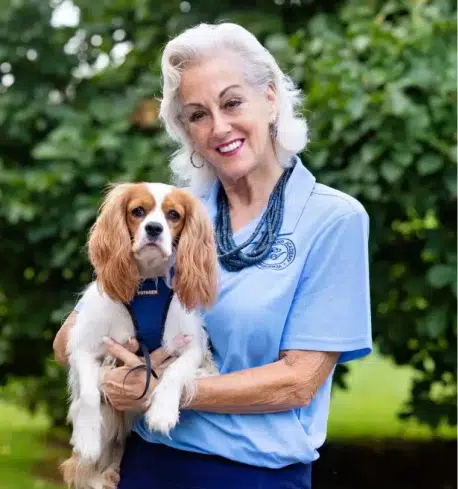
Debbi Scarborough
From 2007 to present, Debbi Scarborough has been the Headmaster and served on the Board of Directors for this non-profit, special needs school that focuses on children with ASD, ADD, and ADHD. Debbi and her husband Matthew founded Cumberland Academy of Georgia after a frustrating battle of searching for the right school for their son Steven who has ASD. She has built the academy from one student to now over 100, and continues to run the day to day operations.Related Posts
Why the Autism and Neurodivergent Community Is Moving Away from “High Functioning”
For years, “high-functioning autism” was one of the most common phrases used to describe autistic people who could speak, work,....
READ POST
Choosing a School Based on Autism Support Needs: Levels 1, 2, and 3
For families of a child with autism, choosing a school may begin with understanding the child’s support needs, including any....
READ POST
The Cumberland Academy Partners with Legacy Golf and PGA TOUR Superstore Roswell to Champion Student-Athletes
ROSWELL, GA — The Cumberland Academy is thrilled to announce its official partnership with Legacy Golf and the PGA TOUR....
READ POST